Corrective Deed
New deed used to correct an error in a previously recorded deed when state law and the title provider require a deed-level cure.
A corrective deed is a new deed used to correct an error in a previously recorded deed. It usually identifies the earlier recording, states what is being corrected, repeats the accurate information, and is executed and recorded under the rules of the property’s state.
Why It Matters
A corrective deed matters because the county land records cannot be repaired by editing the image of an old recorded document. A material mistake in a party’s name, Legal Description, vesting clause, or other deed term can create a Title Defect that delays a sale, refinance, or home-equity loan.
The word corrective does not make a deed valid automatically. State law controls who must sign, whether the original grantor and grantee must participate, what recitals are required, and whether the correction relates back to the earlier recording. A correction that changes the property or the parties’ substantive rights may require more than a simple corrective deed.
The title provider must also accept the cure for the pending transaction. A recorder’s acceptance only places a document in the public record; it does not guarantee that the instrument resolves the lender’s or title insurer’s concern.
Where It Appears in the Borrower Process
Borrowers usually encounter a corrective-deed issue after the Title Search or survey reveals a mismatch. The Title Commitment may list a requirement to correct the earlier deed before the proposed owner and lender policies can be issued.
The closing or title professional first determines what the public record says, what the parties intended, and which curative method local law permits. Depending on the issue, the solution may be a corrective deed, a Scrivener’s Affidavit, a statutory curative notice, a court order, a new conveyance, or another instrument.
Matching the Cure to the Error
| Record problem | Possible curative direction | Why professional review matters |
|---|---|---|
| Minor clerical reference error | Affidavit or statutory notice may be available | Authority and permitted error types vary by state |
| Misspelled or inconsistent party name | Corrective deed or identity evidence may be requested | The cure must connect the correct legal person to the record |
| Incorrect legal description | Corrective deed, statutory procedure, or other action may be required | A correction must not accidentally convey a different parcel |
| Missing required signature or acknowledgment | Re-execution or another authorized instrument may be needed | Recording rules and property rights vary |
| Intended change to owner or ownership share | New conveyance rather than a mere correction | This changes substantive rights and may affect the mortgage |
| Disputed ownership or unavailable signer | Agreement, probate, or court action may be necessary | A unilateral document may not resolve competing rights |
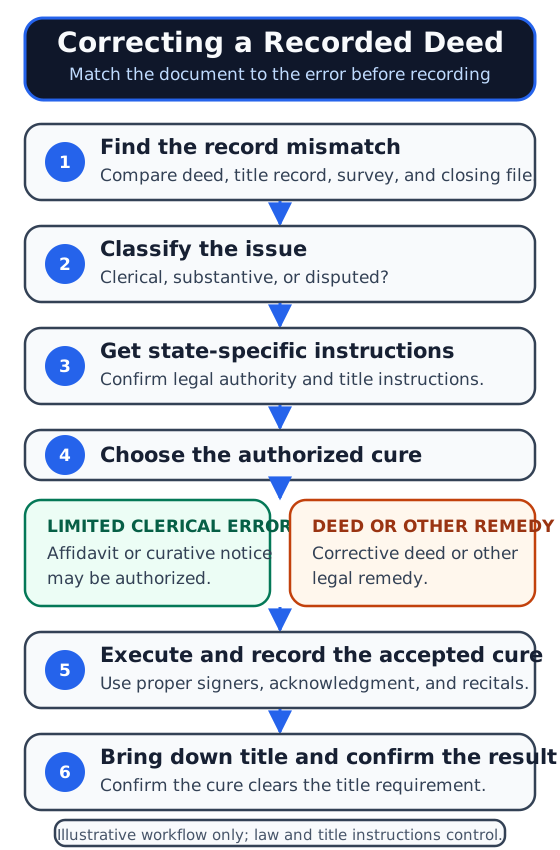
The diagram is a decision framework, not a universal legal procedure. The property’s state law, facts, title underwriting instructions, and recording office requirements determine the actual cure.
Corrective Deed Compared with Nearby Terms
| Term | Borrower-facing distinction |
|---|---|
| Corrective deed | New deed intended to correct a prior recorded deed |
| Scrivener’s Affidavit | Sworn statement that may address a limited clerical error where permitted |
| Owner’s Affidavit | Owner’s factual statements for title underwriting, not a deed correction by itself |
| Title Defect | The underlying record or ownership problem |
| Recording | Public filing step; acceptance does not prove the cure is legally sufficient |
Practical Example
A homeowner applies to refinance. The title search shows that the prior deed names Lot 18, while the purchase contract, survey, and earlier chain of title identify Lot 81. Because changing a lot number can affect which parcel was conveyed, the title company does not treat it as a harmless typo.
The closing professional obtains state-specific legal guidance, confirms the intended parcel and parties, and requests the required corrective instrument. After authorized parties sign and the document is recorded, the title provider performs a Title Bringdown to confirm the new record before clearing the refinance requirement.
How It Differs From Nearby Terms
Corrective deed differs from Deed because deed is the broad transfer-document category, while a corrective deed expressly addresses an earlier recorded deed.
It differs from a Scrivener’s Affidavit because the corrective deed is itself a conveyancing instrument. The affidavit is a sworn statement and is generally limited to errors the applicable law and title provider allow it to address.
It differs from Reformation because reformation is a legal remedy that changes a written instrument to reflect the parties’ actual agreement, often when a voluntary corrective document is unavailable or disputed.
Related Terms
- Deed
- Scrivener’s Affidavit
- Title Defect
- Title Requirement
- Recording
- Title Search
- Title Bringdown
- Legal Description
Knowledge Check
- Can the parties fix a recorded deed by changing the old recorded image? No. A new authorized instrument is generally needed to correct or explain the public record.
- Is every deed error suitable for a scrivener’s affidavit? No. State law may restrict affidavits to specific clerical errors, while a substantive problem can require a corrective deed or another remedy.
- Does the recorder’s acceptance prove that the title requirement is satisfied? No. The title provider still evaluates whether the recorded cure resolves the identified risk.