ARM Rate Cap
Contract limits on how much an adjustable-rate mortgage can change at its first reset, later resets, and over its life.
An ARM rate cap is a contractual limit on how much an adjustable-rate mortgage’s interest rate can change at a reset or over the life of the loan. Most ARM cap structures use separate limits for the first adjustment, later adjustments, and the lifetime maximum.
Why It Matters
The index and margin determine the formula-based rate, but caps determine how quickly and how far that result can reach the borrower. A sharp index increase does not necessarily produce an equally sharp change at the next reset.
Caps reduce uncertainty but do not eliminate it. A loan can rise by the maximum permitted amount over several adjustments and eventually reach its lifetime ceiling. Borrowers should therefore evaluate the entire upward path and the corresponding highest payment, not just the first cap.
Cap terms also distinguish ARM offers that otherwise look alike. Two loans can share the same initial rate, index, and margin yet expose the borrower to different payment paths because one permits a larger first adjustment or more frequent later increases.
Where It Appears in the Borrower Process
Borrowers see cap information in ARM program disclosures, the Loan Estimate’s adjustable-interest-rate information, and the note or ARM rider. The documents should identify the maximum rate and limits on individual changes.
At a reset, the servicer applies the index, margin, rounding, caps, floor, and other contract rules. The ARM Adjustment Notice shows the new rate and payment before they take effect.
The Three Main Rate Caps
| Cap | What it limits | Borrower question |
|---|---|---|
| Initial Adjustment Cap | First change after the fixed period | How large can the first reset be? |
| Periodic Adjustment Cap | Change at each later reset | How quickly can the rate move after that? |
| Lifetime Rate Cap | Maximum over the entire loan | How high can the rate ever become? |
Caps are stated in percentage points, not as percentages of the old rate. A 2-percentage-point cap on a 6.00% rate permits an increase to 8.00%, not an increase to 6.12%.
Reading 2/2/5 Cap Notation
A cap sequence written as 2/2/5 commonly means:
- up to 2 percentage points at the first adjustment;
- up to 2 percentage points at each later adjustment; and
- no more than 5 percentage points above the initial rate over the loan’s life.
The note controls the actual meaning, including downward limits, the starting reference rate, and whether any unapplied change can affect a later reset.
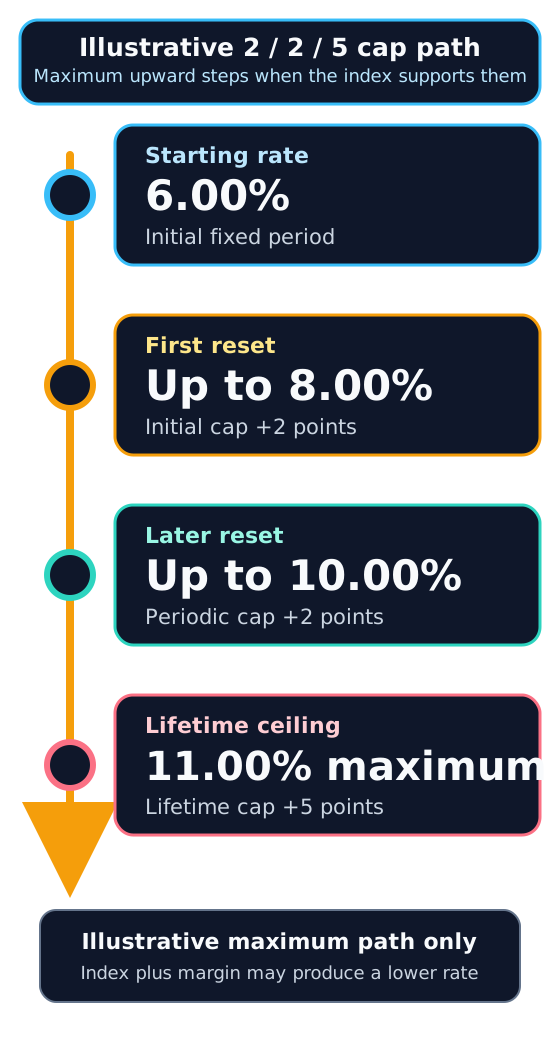
The diagram shows the fastest illustrative upward path when the index-plus-margin result supports each maximum increase. Actual rates may rise less, stay level, or fall.
Practical Example
An ARM starts at 6.00% with a 2/2/5 cap structure. At the first reset, index plus margin equals 9.00%. The initial cap limits the new rate to 8.00%.
At the next reset, the fully indexed rate remains 9.00%. The 2-point periodic cap would permit up to 10.00%, but the formula result is only 9.00%, so the rate can move to 9.00% rather than automatically using the full cap.
If index plus margin later reaches 12.00%, the 11.00% lifetime maximum prevents the note rate from reaching 12.00%. Caps are ceilings on permitted movement, not scheduled rate increases.
Ask Whether a Cap-Limited Increase Can Carry Forward
When a cap blocks part of the formula increase, the gap does not necessarily disappear permanently. Some contracts permit a foregone or carryover increase to affect a later adjustment, subject to later caps and the lifetime maximum. Other structures simply recalculate from the index and margin at each reset under their own terms.
For each notice, record:
- the uncapped index-plus-margin result;
- the rate permitted after the applicable cap;
- any foregone increase identified in the notice; and
- the earliest date the contract allows that amount to affect a later reset.
Do not assume a cap-limited first reset guarantees the same protection at every later reset. The note, rider, and adjustment notice explain whether the loan can continue moving toward a previously constrained formula result.
Cap Does Not Mean Payment Cap
An interest-rate cap limits the rate. A payment cap limits how much the required payment can change. They are not interchangeable.
If a payment is held below the amount needed to cover accrued interest, the unpaid amount can be added to principal under loan terms that permit negative amortization. Borrowers should identify whether disclosures refer to a rate cap, payment cap, or both.
Questions to Ask Before Choosing an ARM
- What is the first-adjustment cap?
- What limit applies to later increases and decreases?
- How often can the rate adjust?
- What is the explicit minimum and maximum rate?
- Is the initial rate discounted?
- How does the loan treat a formula change that a cap prevents from applying immediately?
- What is the highest possible monthly payment?
These answers should come from the disclosures and final loan documents, not from the ARM label alone.
How It Differs From Nearby Terms
An ARM rate cap differs from the Rate Floor. Caps generally limit upward movement or the size of a reset; the floor states how low the rate can fall.
It differs from the Adjustment Period. The period controls when a reset may occur, while caps control the size or outer boundary of the change.
It also differs from the Fully Indexed Rate. The fully indexed rate is index plus margin; caps can keep the actual note rate below that formula result.
Related Terms
- Initial Adjustment Cap
- Periodic Adjustment Cap
- Lifetime Rate Cap
- Rate Floor
- Fully Indexed Rate
- Adjustment Period
- ARM Reset
- Adjustable-Rate Mortgage (ARM)
Knowledge Check
- What does 2/2/5 commonly describe? A 2-point first-adjustment cap, a 2-point later periodic cap, and a 5-point lifetime increase limit.
- Does a 2-point cap mean a 2% increase in the current rate? No. It means 2 percentage points, such as 6.00% to 8.00%.
- Must the rate rise by the full cap at every reset? No. The index-plus-margin result and other contract terms may produce a smaller increase, no change, or a decrease.