Buydown Account
Subsidy funds supplying part of a temporary buydown's scheduled mortgage payment, separate from principal and tax-and-insurance escrow.
A buydown account holds the subsidy money used to supply part of the scheduled mortgage payment during a temporary buydown. The borrower pays a reduced portion, and the account provides the agreed difference toward the full principal-and-interest payment.
Why It Matters
The account explains how a borrower can pay less out of pocket while a fixed mortgage retains its note rate. Someone has supplied money for the difference; the lender has not simply stopped charging the note’s interest rate.
The subsidy is a limited fund with a defined schedule. It is not an emergency account the borrower can withdraw from for repairs, taxes, or other spending. Under Fannie Mae’s temporary-buydown rules, the funds are held in custodial accounts, cannot be used for past-due payments, and cannot reduce the mortgage amount used in LTV calculations.
The contractual payment still matters if a draw is unavailable. The borrower should resolve a missing subsidy with the servicer rather than assume the note obligation has been reduced to the advertised opening amount.
Where It Appears in the Borrower Process
During origination, the lender calculates the scheduled subsidy and reviews who may fund it. Seller- or builder-funded assistance may use part of the applicable Interested Party Contributions allowance.
The Buydown Agreement documents the arrangement. After closing, the servicer applies the scheduled draws alongside the borrower payments. A servicing transfer or early payoff requires the remaining account and instructions to be reconciled under the agreement and applicable program rules.
Monthly Payment Flow
The illustration shows one first-year payment on the $400,000 fixed-rate example below. It covers principal and interest only.
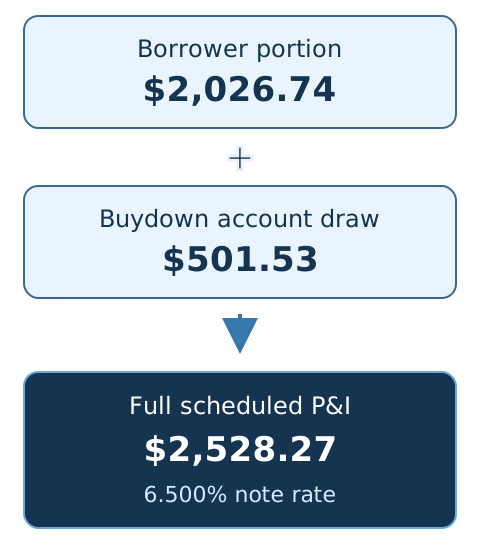
The full scheduled P&I payment remains $2,528.27 at the 6.500% note rate. As the subsidy declines, the borrower supplies more of that payment. Taxes, property insurance, mortgage insurance, and other applicable collections are additional components of the total amount due.
Practical Example
A $400,000, 30-year fixed mortgage at 6.500% has scheduled P&I of $2,528.27. In a 2-1 plan, the borrower portion is $2,026.74 in year one and $2,271.16 in year two. Using those payments rounded to cents, the monthly subsidy is $501.53 and then $257.11.
| Account stage | Illustrative balance |
|---|---|
| Initial subsidy for the full two-year schedule | $9,103.68 |
| After the first $501.53 draw | $8,602.15 |
| After twelve first-year draws | $3,085.32 |
| After twelve further $257.11 draws | $0.00 |
The balance is not extra home equity or a reduction in the mortgage principal. Each draw helps make a scheduled payment; the principal balance follows the loan’s ordinary amortization. Actual account figures follow the lender’s rounding method and written agreement.
If the Mortgage Ends Early
A refinance or sale can leave money in the account. Fannie Mae’s servicing procedure directs the servicer to reduce the amount collected for payoff by the remaining subsidy, without first reducing the mortgage principal used to calculate interest. Ask for that treatment to be reconciled on the Payoff Statement; do not subtract the balance again from a quote that already includes the credit.
Any funds remaining after payoff must be handled under the applicable agreement and investor rules. Selling-guide provisions can permit specified returns after early payoff, but that is not a reason to replace the servicer’s actual payoff calculation with an assumed cash refund.
The account also differs from a delinquency reserve. A scheduled subsidy does not authorize the borrower to skip a payment or direct the remaining balance toward arrears whenever desired.
During servicing, a Buydown Payment Change Notice helps identify the next scheduled reduction in the account’s contribution and increase in the borrower portion.
How It Differs From Nearby Terms
A buydown account differs from an Escrow Account used for property taxes and insurance. Both involve held funds, but they pay different obligations and follow different account rules.
It differs from a Buydown Agreement, the document governing the account and schedule.
It differs from Discount Points. Points generally purchase a lower note rate; a temporary subsidy account supplies part of payments due under the existing note terms.
Related Terms
- Buydown Agreement
- Temporary Buydown
- 2-1 Buydown
- Principal and Interest (P&I)
- Escrow Account
- Interested Party Contributions
- Discount Points
- Payoff Statement
Knowledge Check
- Does the account balance reduce the mortgage principal when the account is funded? No. The balance supplies scheduled payment subsidies; it is not an immediate principal reduction.
- Why does the borrower portion rise in a typical 2-1 plan? The scheduled account subsidy declines and then ends, while the full note-rate P&I payment remains due.
- Can the borrower use the account like a savings account for home repairs? No. It holds funds for the specified subsidy schedule and permitted disposition under the agreement.
Suggest a correction
The form needs JavaScript. You can always use the email link above.
Corrections and updates
No public change summaries have been recorded yet. Earlier revisions may not be listed.
How we record changes