Balloon Payment
Large lump-sum mortgage payment due at a set point, often at maturity of a balloon loan.
A balloon payment is a large one-time amount due at or near the end of a mortgage term because the earlier scheduled payments did not fully repay the principal balance.
The payment is much larger than the regular installments. It commonly appears when monthly payments are calculated over a longer amortization period than the loan’s actual maturity.
Why It Matters
A balloon structure can make the regular payment look affordable while deferring a major repayment obligation. The borrower may expect to refinance, sell the property, or use other funds before maturity, but none of those outcomes is guaranteed.
If property value falls, income declines, credit weakens, rates rise, or suitable products disappear, refinancing may not be available when the balloon comes due. Failure to pay the amount is a mortgage default and can place the collateral at risk.
How a Balloon Payment Is Created
The key is the difference between two timelines:
- amortization period: the longer schedule used to calculate regular payments
- loan term: the shorter period ending at the contractual Maturity Date
When the term ends before the amortization schedule reaches zero, the remaining principal is due in a lump sum.
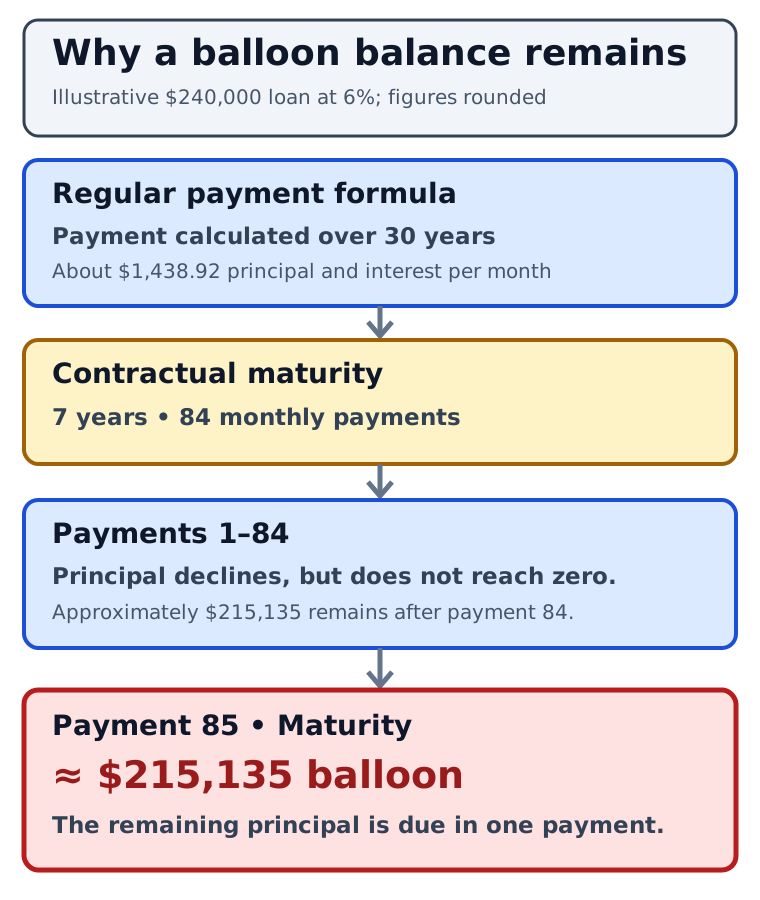
The illustration uses a $240,000 loan at 6% with payments calculated over 30 years but a 7-year maturity. It is an educational example, not a current loan offer.
Practical Example
Assume a $240,000 fixed-rate loan at 6% has a principal-and-interest payment calculated over 30 years. The scheduled payment is about $1,438.92 per month, but the legal loan term is only 7 years.
After 84 regular payments, the approximate principal balance is still $215,135. When the 7-year term ends, that remaining balance becomes due as the balloon payment, along with any other amount required by the loan and payoff calculation.
| Item | Illustrative amount |
|---|---|
| Original loan amount | $240,000 |
| Amortization period used for payment | 30 years |
| Actual loan term | 7 years |
| Regular principal-and-interest payment | About $1,438.92 |
| Approximate balance after 84 payments | $215,135 |
Where It Appears in the Borrower Process
Borrowers should identify a balloon feature before closing, not only when maturity approaches:
| Document or stage | What to check |
|---|---|
| Loan Estimate | Whether the loan terms identify a balloon payment |
| Closing Disclosure | Final balloon feature, timing, and projected payments |
| Promissory Note | Contractual maturity and amount-payment provisions |
| Amortization Schedule | Balance projected to remain at the balloon date |
| Mortgage Statement | Current balance and account status as maturity approaches |
| Payoff Statement | Exact amount required through a specified payoff date |
Exit Strategies and Their Risks
| Planned strategy | What can go wrong |
|---|---|
| Refinance before maturity | Qualification, appraisal, rates, or product availability may change |
| Sell the property | Sale timing or proceeds may be insufficient |
| Pay from savings or investments | Funds may not grow as expected or may be needed elsewhere |
| Receive an extension or renewal | The lender may have no obligation to extend unless the contract clearly provides one |
A credible plan should include time, backup options, and current balance monitoring. “I will refinance later” is an expectation, not proof that future credit will be approved.
Balloon Payment Compared With Nearby Terms
| Term | Main distinction |
|---|---|
| Balloon payment | Large lump sum due because regular payments did not fully retire the balance |
| Final amortizing payment | Last scheduled payment in a loan designed to reach zero by maturity |
| Balloon Mortgage | Loan structure that requires the balloon payment |
| Interest-Only Mortgage | Delays scheduled principal reduction during an initial period but does not always have a balloon maturity |
| Payoff Amount | Total required to satisfy a loan on a stated date, whether or not the loan has a balloon feature |
An ordinary final payment can differ slightly from earlier payments because of rounding or final interest. That small adjustment is not the same as a true balloon payment.
What Happens Near Maturity
The servicer may send notices as the maturity date approaches, but the borrower remains responsible for knowing the contract. The practical steps are:
- Confirm the maturity date and current principal balance.
- Request a payoff statement for the expected payoff date.
- Start refinance or sale planning early enough for delays.
- Ask about contractual renewal rights, if any, without assuming approval.
- Seek prompt help if the amount cannot be paid as agreed.
Waiting until the final payment month can leave too little time for appraisal, underwriting, title work, sale, or another resolution.
How It Differs From Nearby Terms
Balloon Mortgage names the loan structure. Balloon payment names the large final obligation created by that structure.
Fully Amortizing Mortgage is designed to reach a zero balance through scheduled payments by maturity. A balloon structure ends before the longer amortization path would finish.
Acceleration can make the full balance due early after a contractual trigger such as uncured default. A balloon payment is scheduled from the beginning for a stated future date.
Related Terms
- Balloon Mortgage
- Maturity Date
- Payment Schedule
- Fully Amortizing Mortgage
- Amortization Schedule
- Payoff Amount
- Payoff Statement
- Refinance
Knowledge Check
- Why can regular payments be much smaller than the balloon payment? They may be calculated over an amortization period much longer than the actual loan term.
- Is a future refinance guaranteed to cover the balloon? No. Future qualification, value, rates, and product availability can change.
- How is a balloon different from acceleration? A balloon is scheduled in the original payment structure, while acceleration makes the balance due early after a contractual trigger.