Construction Draw
Staged release of construction-loan funds after approved work and supporting documents satisfy lender requirements.
A construction draw is one staged release of construction-loan funds after approved work, costs, and supporting documents satisfy the lender’s requirements. Each draw increases the amount advanced under the loan and reduces the undisbursed commitment available for later stages.
The full construction budget is not usually paid to the builder at closing. Funds remain controlled so the lender can connect disbursements to project progress.
Why It Matters
Draw timing determines whether the builder has enough money to pay subcontractors and suppliers while the lender still retains enough funds to finish the project. A draw that is too early can release money before value has been created. A draw that is too small or delayed can interrupt work and create contractor or lien problems.
Borrowers also need to distinguish three numbers:
- the total construction commitment
- the amount already advanced and owed
- the amount still available for approved future draws
Those figures change throughout the project. The undisbursed amount is not unrestricted cash and may be unavailable for work outside the approved budget.
Where It Appears in the Borrower Process
Draw procedures are established before closing through the loan agreement, construction contract, budget, and Construction Draw Schedule. After work begins, the borrower or builder submits a request using the lender’s required format.
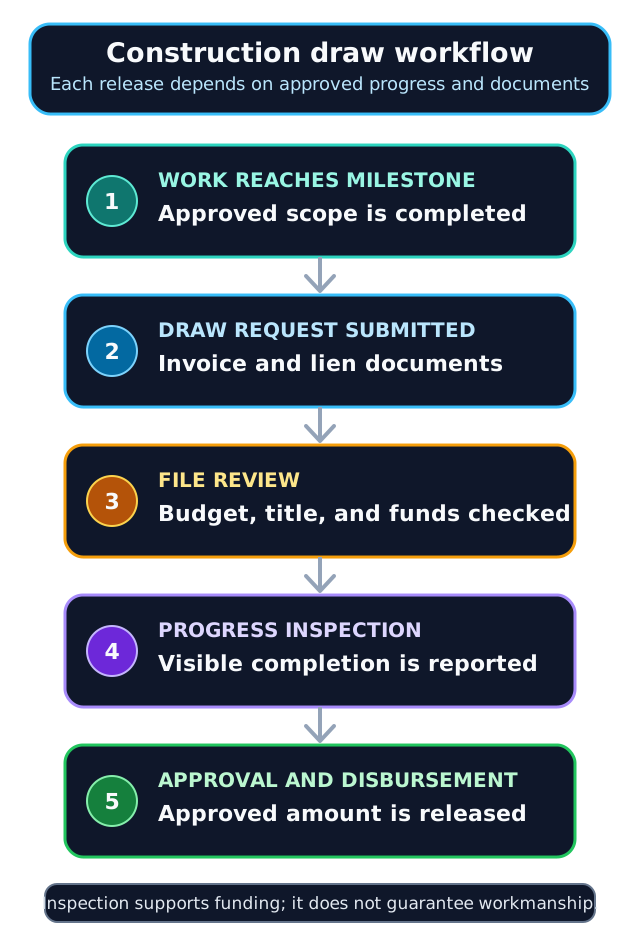
A typical request can include:
- amount requested by budget category
- contractor invoice or sworn statement
- proof of completed work or stored materials
- required lien waivers or title update
- approved change orders
- borrower authorization
- progress report or Construction Draw Inspection
The lender compares the request with work completed, prior advances, remaining budget, retainage, title status, and loan conditions. It can approve the request, reduce it, or hold it until missing conditions are resolved.
Draw Workflow
| Step | Main question |
|---|---|
| Milestone | Has an approved stage of work been reached? |
| Request | Does the request identify eligible costs and required payees? |
| Document review | Do invoices, lien documents, budget, and prior draws reconcile? |
| Inspection | Does visible progress support the requested amount? |
| Disbursement | How much is approved, and to whom will it be paid? |
The borrower should not promise a contractor that a draw will arrive on a specific date without accounting for the lender’s review and funding time.
How the Money May Be Paid
Depending on the loan, an approved draw may be paid to the builder, borrower, title or escrow agent, suppliers, or multiple joint payees. The payment route is designed to document project costs and reduce the risk of unpaid parties asserting a Mechanic’s Lien.
Some lenders retain part of each approved amount until later completion. Retainage is separate from the Construction Contingency Reserve: retainage temporarily withholds payment already tied to work, while contingency funds address approved unforeseen costs.
Practical Example
A construction loan has a $500,000 commitment. The lender has already advanced $140,000, leaving $360,000 undisbursed. After framing and roof sheathing are completed, the builder requests a $95,000 draw.
The inspection and invoices support $88,000, but $7,000 relates to materials not yet delivered and is not currently eligible. The lender releases $88,000. The total advanced balance becomes $228,000, before interest and other charges, and $272,000 remains for approved future draws.
The denied portion was not necessarily removed from the project. It may become eligible after the materials arrive and the next request documents them.
Why a Draw Can Be Delayed
Common reasons include incomplete invoices, expired insurance, unresolved title matters, missing lien waivers, work that does not match approved plans, an unapproved change order, insufficient progress, or concern that the remaining budget cannot complete the project.
A delay does not always mean the construction loan is in default. It can mean the lender lacks enough evidence to make the requested advance under the agreed controls.
How It Differs From Nearby Terms
A construction draw differs from a Construction Draw Schedule. The schedule is the planned map of milestones and releases; a draw is one actual advance.
It differs from a Construction Draw Inspection. The inspection reports progress; the draw is the funding decision and disbursement that may follow.
It differs from a Repair Draw, which releases property-insurance proceeds held by a mortgage servicer after a loss. It also differs from a HELOC Draw, which is a borrower’s advance from an open-end credit line rather than a milestone-based project disbursement.
Related Terms
- Construction Loan
- Construction Draw Schedule
- Construction Draw Inspection
- Construction Interest Reserve
- Construction Contingency Reserve
- Construction-to-Permanent Loan
- Mechanic’s Lien
- Repair Draw
Knowledge Check
- Does the undisbursed construction commitment belong to the builder as unrestricted cash? No. It remains controlled and can be advanced only under the loan’s approved purposes and conditions.
- What happens to the loan balance when a construction draw is funded? The amount advanced increases, and the remaining undisbursed commitment decreases.
- Does an inspection automatically require the lender to fund the full request? No. The lender also reviews the budget, documents, title conditions, prior advances, and remaining completion funds.