Repayment Period
Later HELOC phase when draw access ends and the outstanding balance follows the plan's payoff schedule.
The repayment period is the later HELOC phase when draw access ends and the outstanding balance follows the plan’s payoff schedule. Payments generally become focused on principal and interest rather than revolving access.
Not every HELOC provides a long repayment period. Depending on the agreement, the borrower may have an amortizing schedule, a shorter payoff phase, or a large amount due when draw access ends.
Why It Matters
Repayment period matters because a HELOC can feel manageable during its flexible early years, while the later structure can require much more principal to be paid each month.
A borrower who plans only around draw-period flexibility may therefore face Payment Shock when the line changes phases. The payment can also continue changing if the rate remains variable.
The transition does not erase the balance or create a new pool of credit. Amounts already drawn remain secured by the property, and paying principal during the repayment period generally does not reopen draw access.
It also points toward the eventual HELOC Maturity Date, when any remaining balance must be resolved under the line terms.
Where It Appears in the Borrower Process
Borrowers encounter repayment-period terms in application disclosures and the line agreement before opening. Those documents should describe the length of the draw period, any repayment period, the payment method, and whether a balloon amount may result.
The term becomes practical again as the draw end date approaches. The borrower should review notices and statements, request a projected payment if available, and confirm the balance, rate structure, and maturity date.
If the scheduled repayment payment is unaffordable, possible responses such as extra principal payments, a fixed-rate conversion, refinancing, sale, or lender assistance should be explored before the transition. Each option has eligibility, timing, cost, and risk considerations; renewal or refinancing is not guaranteed.
HELOC Phase Transition
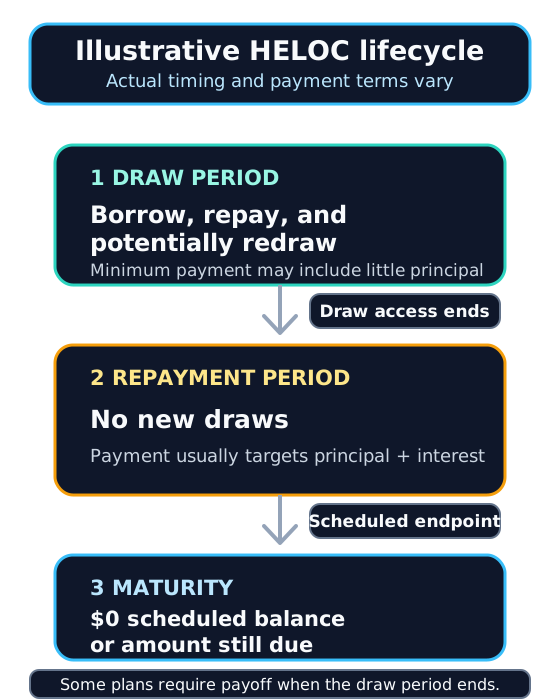
The sequence is typical, but timing and payment terms vary. Some agreements require the full balance when the draw period ends instead of providing a multi-year repayment schedule.
Repayment Period Compared with Earlier HELOC Payment Behavior
| Stage | Typical borrower experience |
|---|---|
| Draw Period | Ongoing access to the line and often lighter required payments |
| Interest-Only Payment phase, if allowed | The borrower may keep the line current without reducing much principal |
| Repayment period | New borrowing fades out and the required payment usually becomes more principal-focused |
| Payment Shock | The budget effect borrowers often feel when the required payment rises sharply |
What Changes at the Transition
| Feature | During draw period | During repayment period |
|---|---|---|
| New advances | May be available under account terms | Generally stop |
| Principal paid | May restore available credit | Reduces debt but generally does not restore draw access |
| Minimum payment | May be interest-only or include limited principal | Usually includes principal on a payoff schedule |
| Rate | Often variable | May remain variable unless fixed under the agreement |
| Borrower focus | Managing access and balance | Reaching payoff by maturity |
Practical Example
A homeowner reaches the end of a 10-year draw period with a $60,000 balance. During the draw period, a simplified interest-only payment at 8% would be about $400 per month. The agreement then amortizes the balance over 15 years.
If the rate were still 8%, a simplified fully amortizing principal-and-interest payment would be about $573 per month. The actual amount can differ because HELOCs may use variable rates, daily interest calculations, fees, and account-specific payment rules. The important change is that the later payment must now reduce principal on the stated schedule.
Preparing for Repayment
- Confirm the exact draw end date and first repayment-period due date.
- Obtain the current balance and understand pending draws or payments.
- Review whether the rate remains variable and how often it adjusts.
- Ask for an estimated repayment payment using the current balance and rate.
- Check for fixed-rate conversion, renewal, or refinance options before deadlines.
- Include the higher payment in the household budget before it becomes due.
- Identify any balloon requirement at draw end or final maturity.
How It Differs From Nearby Terms
Repayment period differs from Draw Period because the draw period is the active borrowing phase, while the repayment period is the paydown-focused phase.
It differs from Home Equity Loan. A home equity loan begins as a lump-sum obligation with scheduled repayment; a HELOC usually has a revolving phase before its payoff-focused phase.
It differs from Line Freeze. A freeze is an account restriction that may occur during the scheduled draw period; repayment is the planned later phase.
It also differs from Payment Shock. Repayment period is the later phase of the HELOC itself, while payment shock is the borrower-facing effect that can result when that phase begins.
It differs from HELOC Maturity Date. The repayment period is a span of time; maturity is the final contractual date by which the remaining obligation must be resolved.
Related Terms
- Home Equity Line of Credit (HELOC)
- Draw Period
- Credit Limit
- Interest-Only Payment
- Payment Shock
- HELOC Maturity Date
- Line Freeze
- HELOC Minimum Payment
Knowledge Check
- Why can the repayment period surprise HELOC borrowers? Because the line no longer functions like the earlier revolving draw phase and the payment burden can feel much heavier.
- Is the repayment period the same thing as a line freeze? No. Repayment period is the planned later phase of the HELOC, while a line freeze is a restriction event or status.