Open-End Home Equity Credit
Revolving credit secured by a home that supports repeated draws and repayments within an approved limit.
Open-end home equity credit is a revolving credit plan secured by a home. It allows repeated draws, repayments, and possible redraws within an approved limit while the plan permits new advances.
Why It Matters
Open-end describes the structure behind most HELOCs. Unlike a one-time installment loan, the account can remain available for multiple borrowing decisions during its draw period. Interest and minimum-payment calculations generally respond to the amount actually used, while the unused limit remains potential capacity.
That flexibility creates continuing decisions and risks. A borrower must monitor the outstanding balance, variable rate, minimum payment, available credit, access status, and the date when new draws stop. Reusing principal that was repaid can also keep debt outstanding longer than the borrower initially planned.
The plan is secured by the dwelling. Failure to meet the agreement can put the home at risk, even if the funds were used for an expense unrelated to the property.
Where It Appears in the Borrower Process
Borrowers encounter the term on HELOC applications, early disclosures, account-opening documents, and rules governing open-end credit secured by a dwelling. The documents explain the draw and repayment periods, access methods, rate behavior, payment method, fees, security interest, and circumstances that can restrict future advances.
After opening, the concept appears on every statement: the credit limit, balance, available credit, new draws, payments, finance charges, and fees describe a revolving account rather than a fixed advance. When the draw period ends, the plan may enter repayment, require another arrangement, or have a different endpoint specified by the agreement.
Open-End Features
| Feature | Borrower-facing effect |
|---|---|
| Credit Limit | Sets the approved maximum line |
| Available Credit | Shows unused capacity that may remain drawable |
| Draw Period | Defines when the line can usually be used |
| Repayment Period | Later phase when draws usually stop and repayment takes over |
| Variable rate | Common pricing structure that can change borrowing cost over time |
| Security interest | Gives the lender a lien against the home |
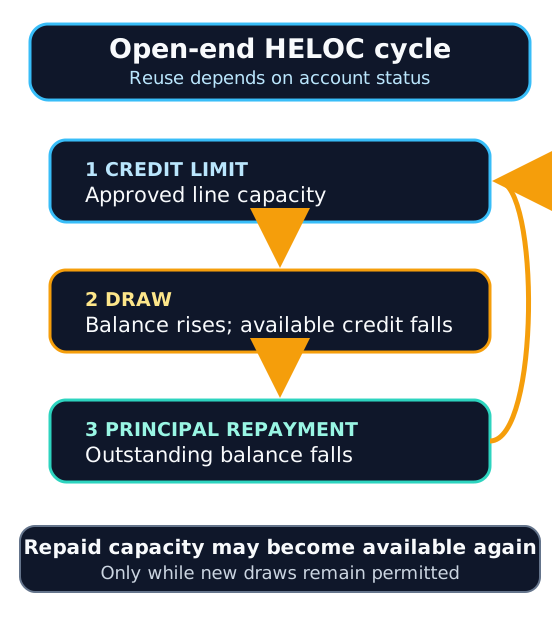
The cycle can repeat only while the plan remains open for advances and the account has drawable capacity. Repayment after the draw period reduces debt but normally does not restore borrowing access under the original schedule.
Practical Example
A homeowner opens a $90,000 HELOC for a renovation with uncertain timing. The borrower draws $15,000 for design and permits, then repays $5,000 of principal. If the draw period remains open and no restriction applies, the line may again show about $80,000 available before pending activity or fees.
The borrower later draws $30,000 for construction. Those separate advances are part of one open-end plan rather than two new mortgage originations. Each draw increases the balance secured by the home.
Borrower Questions to Ask
- How long are the draw and repayment periods?
- Which access methods are available, and are there minimum draws or transaction fees?
- How is the variable rate calculated, and what rate ceiling applies?
- How is the minimum payment calculated in each phase?
- Does a principal payment restore available credit during the draw period?
- What annual, early-closure, or conversion fees may apply?
- What events can suspend advances or reduce the line?
- What happens to the remaining balance when the draw period ends?
The answers belong in the actual plan documents. Product advertisements and a quoted introductory rate do not describe the full long-term obligation.
How It Differs From Nearby Terms
Open-end home equity credit differs from Home Equity Line of Credit (HELOC) because HELOC is the common product label, while open-end describes the revolving credit structure behind it.
It differs from Closed-End Second Mortgage because a closed-end second mortgage advances a fixed amount rather than a reusable line.
It also differs from a Credit Limit. The limit is one account term; open-end credit is the entire revolving legal and payment structure.
Open-end does not mean permanent or unconditional. The agreement has a scheduled term, new advances can end with the draw period, and applicable rules permit certain restrictions or changes under specified conditions.
Related Terms
- Home Equity Line of Credit (HELOC)
- Closed-End Second Mortgage
- Credit Limit
- Available Credit
- HELOC Draw
- Draw Period
- Repayment Period
- Line Freeze
Knowledge Check
- A borrower repays principal during the draw period. Does that always guarantee the same amount can be borrowed again? No. Redraw depends on the agreement, current available credit, draw-period timing, and access status.
- Why is a HELOC still mortgage debt when no funds are currently drawn? The open line is secured by a recorded interest in the home, even though a zero balance may produce little or no current interest.