HELOC Conversion Option
HELOC feature that may let a borrower convert eligible variable-rate balance into a fixed-rate or fixed-payment segment.
A HELOC conversion option is a contractual feature that may let a borrower move an eligible amount from the variable-rate HELOC balance into a fixed-rate repayment segment. The feature changes how that portion is priced and repaid without necessarily replacing or closing the overall line.
Not every HELOC offers conversion, and an available feature may limit the amount, timing, number of fixed segments, or repayment terms. The line agreement controls eligibility.
Why It Matters
HELOC conversion option matters because many HELOCs start as variable-rate revolving lines. A borrower who wants more payment predictability may be able to isolate part of the balance from later index changes if the agreement allows it.
The feature matters most when interest rates, project budgeting, or future payment shock become concerns. Conversion can create a set payment schedule for one segment while the remaining revolving balance continues under variable-rate terms.
Conversion is not automatically a cost reduction. The offered fixed rate may be above the current variable rate, and the lender may charge a conversion fee. The value is greater predictability for the converted amount, not a guarantee of lower interest.
Where It Appears in the Borrower Process
Borrowers encounter conversion-option language while comparing HELOC offers and reviewing account-opening disclosures. After the line is open, the feature may appear in online banking, statements, or a lender’s conversion request process.
The term becomes practical after a draw, when the borrower is deciding whether to keep that balance variable, create a Fixed-Rate Advance, refinance the HELOC, or repay the balance. A borrower should obtain the offered fixed rate and payment schedule before confirming the conversion.
What the Agreement May Control
| Conversion term | Question to ask |
|---|---|
| Eligible amount | Can the borrower convert all or only part of the outstanding balance? |
| Minimum or maximum | Is there a minimum conversion amount or a limit per segment? |
| Timing | Is conversion available only during the draw period or at specified times? |
| Fixed rate | How and when is the fixed rate determined? |
| Repayment term | Over how many payments will the converted amount amortize? |
| Number of segments | Can more than one fixed segment exist at once? |
| Fee | Is there a conversion or setup charge? |
| Early payoff | Can the fixed segment be prepaid, and how are payments applied? |
The borrower’s current variable rate does not determine the fixed offer by itself. A lender may price the fixed segment using a separate method stated in the plan.
One Line, Different Balance Treatments
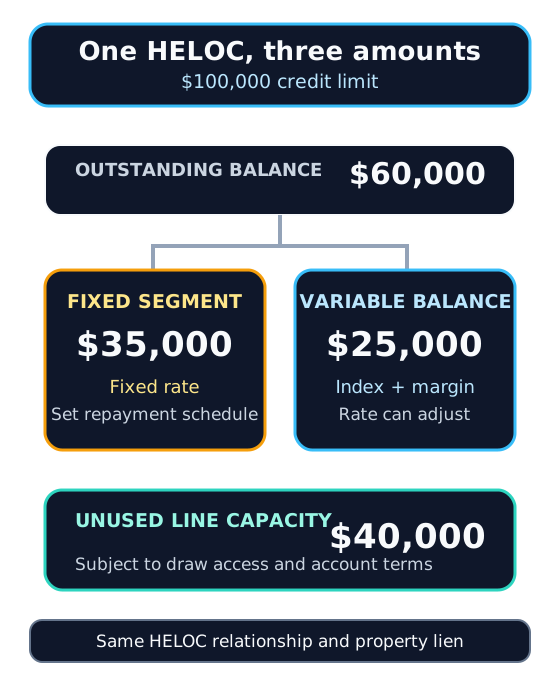
The diagram is an account illustration, not a claim that every HELOC tracks capacity the same way. Whether principal paid on a fixed segment restores revolving capacity depends on the plan and account phase.
Conversion Option Compared
| Term | What it describes |
|---|---|
| Variable-Rate HELOC | Line where the rate can change under the agreement |
| HELOC conversion option | Feature that may convert an eligible balance segment |
| Fixed-Rate Advance | Fixed-rate segment or advance within the HELOC structure |
| Refinance | Replacement financing path rather than an internal line feature |
Practical Example
A homeowner has a $100,000 HELOC and has drawn $60,000 for renovations. The plan permits eligible balances to be converted in fixed segments. The borrower converts $35,000 into a fixed-rate installment segment and leaves $25,000 on the variable-rate line.
After conversion, the borrower may see two payment components: one for the $35,000 fixed segment and another for the $25,000 variable balance. The remaining $40,000 is unused line capacity before pending activity or restrictions. The conversion does not turn the entire HELOC into a home equity loan and does not remove the lien securing the account.
Before Exercising the Option
- Compare the offered fixed rate with the current variable rate, but also compare rate risk over the intended payoff period.
- Confirm the fixed segment’s payment, term, and total scheduled interest.
- Identify conversion fees and any minimum amount.
- Ask how payments are allocated when both fixed and variable balances exist.
- Confirm whether principal repayment restores available credit during the draw period.
- Check what happens to the segment when the draw period ends or the HELOC is closed.
A conversion confirmation should show the amount moved, fixed rate, repayment schedule, and effective date. If the borrower merely has the right to convert but has not exercised it, the eligible balance remains subject to its current variable-rate terms.
How It Differs From Nearby Terms
HELOC conversion option differs from Fixed-Rate Advance because the conversion option is the contractual feature or right, while the fixed-rate advance is the resulting balance segment or transaction after the feature is used.
It differs from Variable-Rate HELOC because variable-rate HELOC describes the broader line structure.
It also differs from Cash-Out Refinance because conversion restructures part of an existing HELOC balance rather than replacing the first mortgage and advancing cash through a new first-lien loan.
Finally, conversion differs from a Rate Lock. A mortgage rate lock protects specified loan pricing during an application or closing period. A HELOC conversion establishes fixed treatment for an eligible balance under an already-open line.
Related Terms
- Home Equity Line of Credit (HELOC)
- Variable-Rate HELOC
- Fixed-Rate Advance
- HELOC Rate Adjustment
- Outstanding HELOC Balance
- HELOC Minimum Payment
- Payment Shock
- Rate Lock
Knowledge Check
- Why might a borrower use a HELOC conversion option? To make part of a variable HELOC balance more predictable if the line terms allow it.
- Is a conversion option the same as replacing the first mortgage? No. It is a feature inside the HELOC structure, not a first-mortgage refinance.