Gift Funds
Money given without repayment for an eligible mortgage purpose, subject to donor, source, transfer, and documentation rules.
Gift funds are money given to a mortgage borrower without an expectation of repayment and used for an eligible purpose such as a down payment, closing costs, or reserves.
Whether a gift is allowed, who may provide it, and how it must be documented depend on the loan program, occupancy, property type, and transaction.
Why It Matters
Gift funds can help a borrower who can afford the monthly payment but needs more money for the upfront transaction. They can reduce the amount the borrower must supply personally without adding another person to the note.
The no repayment condition is essential. Money described as a gift but subject to a private payback agreement is borrowed money. That undisclosed obligation can change debt qualification and make the stated source unacceptable.
An account balance also is not enough by itself. The lender may need to establish that the Gift Donor is eligible, the donor had an acceptable source, the gift terms are documented, and the transferred amount reached the borrower or settlement agent.
Where It Appears in the Borrower Process
Gift planning should begin during preapproval, before the donor transfers money. The loan officer can identify whether the proposed donor and purpose fit the likely program and which records must be preserved.
During underwriting, the gift is part of Verification of Assets and Source of Funds review. Near closing, the lender may confirm the final transfer and match it with the gift letter, account records, and settlement statement.
Late undocumented transfers can create avoidable conditions. A borrower should not assume that depositing cash or moving money through an undisclosed account will make the gift easier to use.
How a Gift Becomes Verified
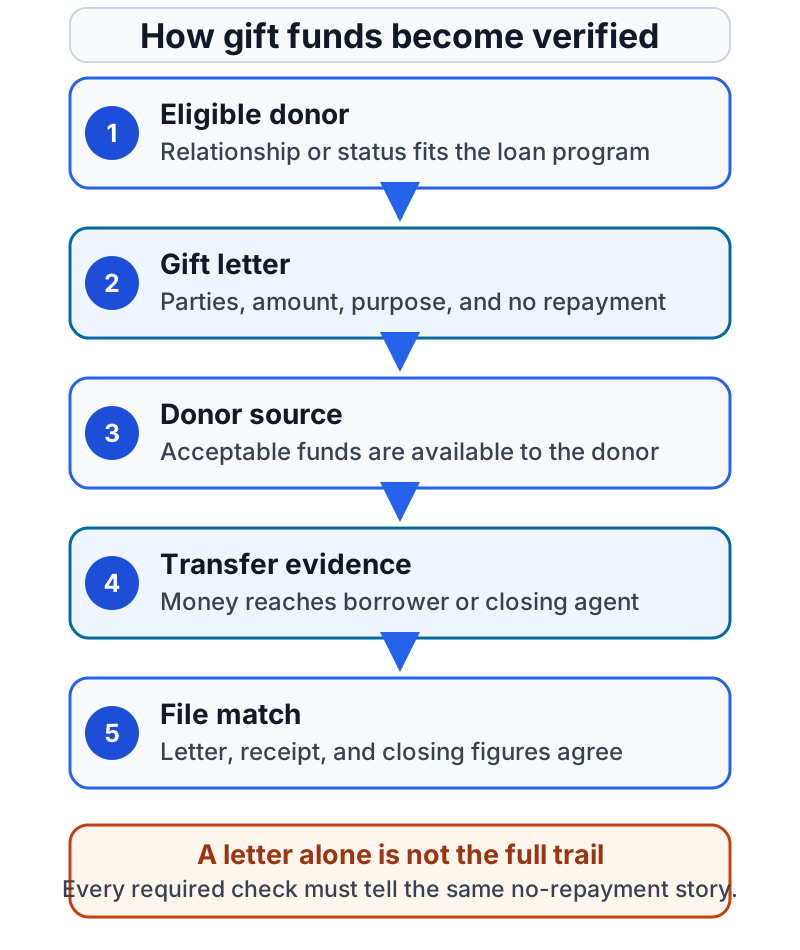
| Check | What the lender is trying to establish |
|---|---|
| Donor eligibility | The donor relationship or status fits the selected loan program |
| Gift Letter | The parties, amount, purpose, and no-repayment terms are documented |
| Donor source | The money came from an acceptable source available to the donor |
| Transfer evidence | The trail shows money moving to the borrower or closing agent as permitted |
| Receipt and file match | The amount and timing agree with account records and closing documents |
A signed letter completes only one part of this sequence. It does not prove by itself that the donor was eligible, had the funds, or completed the transfer.
What Gift Funds May Cover
| Potential use | Important limitation |
|---|---|
| Down Payment | A Minimum Borrower Contribution may still apply |
| Closing costs | The program must permit the gift for that purpose |
| Financial reserves | Some programs and transactions permit gifts for reserves; others restrict them |
| Earnest money already paid | The file must connect the donor funds with the earlier deposit |
Personal gift rules commonly differ for a primary residence, second home, and investment property. A borrower should verify the selected program rather than relying on a donor or use that worked for someone else.
Practical Example
Maya needs $32,000 for her down payment and closing costs. She has $20,000 in verified personal funds, and an eligible relative offers a $12,000 gift.
Before the transfer, the lender provides its gift-letter requirements. The donor signs the letter, transfers $12,000 from a documented account directly to Maya’s account, and both sides retain the transfer record. Underwriting matches the letter, donor evidence, deposit, and final cash-to-close plan.
If Maya had to repay the $12,000 after closing, it would not be a genuine gift regardless of what the letter called it.
How It Differs From Nearby Terms
Gift funds differ from Gift of Equity because gift funds are transferred money. A gift of equity is value provided through a below-market home sale.
They differ from Down Payment Assistance because assistance comes through a program and may be a grant, forgivable loan, deferred second mortgage, or repayable loan.
They differ from Seller Concessions because seller concessions are transaction credits subject to interested-party limits, not personal gift funds from a donor.
They differ from Cash Reserves because reserves describe accepted assets left after closing. Gift funds describe the source of money and may or may not be permitted to satisfy reserves.
Related Terms
- Gift Donor
- Gift Letter
- Gift of Equity
- Minimum Borrower Contribution
- Down Payment
- Source of Funds
- Verification of Assets
- Cash to Close
Knowledge Check
- Does a signed gift letter prove that a mortgage gift is fully verified? No. The lender may also need to verify donor eligibility, source, transfer, and receipt.
- Can money with a private repayment agreement be treated as a true gift? No. A repayment obligation makes it borrowed money, regardless of the label used.
- Are gift funds permitted for every purpose and property type? No. The allowed donor, purpose, occupancy, and property rules depend on the mortgage program.